
Speaker box design for beginners
Never built a speaker box? This interactive tutorial covers which box to build, how tuning works and how to keep your vent quiet, then shows you how to design one in the app. Drag the sliders as you go.
Do you know how box tuning works?
Why a speaker needs a box
A speaker cone pushes air from both sides. When it moves forward, the front pushes air out and the back sucks air in — the two sounds are opposites.
With nothing between them, the back sound wraps around the edge and cancels the front one. High notes survive, but bass almost disappears.
A box traps the back wave. How the box deals with that trapped air is the whole difference between the box types.
- Fs
- How low the speaker likes to go, in hertz (Hz). It is the note the cone "rings" at on its own.
- Qts
- How controlled the cone is. Roughly: under 0.4 often suits a ported box, 0.4–0.7 a sealed one.
- Vas
- How stiff the cone's suspension is, as a volume of air in litres. A big Vas usually means a bigger box.
- Xmax
- How far the cone can travel before it distorts, in millimetres. It sets how loud it can play deep notes.
Your speaker's four important numbers
Every box is designed around the speaker that goes in it. Speaker makers print a list of figures called Thiele/Small parameters. You only need four to start.
You do not have to work anything out with them — the app does that. But when the guide says "tune near Fs", Fs is the number on your speaker's spec sheet.
No spec sheet? The app can estimate them from the speaker's type and size. More detail: Thiele/Small parameters explained.
The four box types
Sealed — a closed box. Ported — a box with a vent (a "port"). 4th-order bandpass — two chambers, one vented. 6th-order bandpass — two chambers, both vented.
Going down that list, the boxes get louder but harder to build, and they give up accuracy for output. The next scenes take them one at a time.
Sealed box
Tight, fast and accurate — every note clean and separate.
Best for: studios and recording — mixing and monitoring, where you must hear the bass exactly as it is — plus careful home listening and small cars. Choose it for accuracy.
- Studio & recording — great for
- Home music — great for
- Movies — works for
- Car — great for
- Outdoor & parties — not ideal for
Advantages
- Tightest, most accurate bass of any box
- Smallest box, and the easiest to build — no vent at all
- The trapped air protects the cone, even on very deep notes
- Very forgiving: a box a bit too big or small still sounds fine
Disadvantages
- Least efficient — needs the most amplifier power for the same loudness
- Not very loud outdoors
- Less deep "weight" than a vented box with the same speaker
Typical tuning: none — a sealed box has no vent, so there is nothing to tune. You only choose its size.
Ported box
Deep, efficient and flat — the all-rounder.
Best for: casual, everyday music and movies — home stereo, home theatre, the car, a small party. Choose it for deep bass with good loudness.
- Studio & recording — works for
- Home music — great for
- Movies — great for
- Car — great for
- Outdoor & parties — works for
Advantages
- About 3 dB more deep bass than sealed — like doubling the amplifier
- Goes deeper than a sealed box with the same speaker
- One chamber, one vent: the easiest vented box to build
- Excellent for movies — reaches the 25–35 Hz rumble
Disadvantages
- Bigger than sealed
- Below its tuning the cone flaps freely — use a subsonic filter
- The vent can "chuff" (whoosh) if it is too small
- The vent must be cut to the right length
Typical tuning: one tuning, usually close to the speaker's Fs — often 30–40 Hz for a subwoofer.
4th-order bandpass
Only the deep stuff — smooth sub-bass with no boom on top.
Best for: loud, deep sub-bass in a car or a home theatre, and outdoors at a decent level — beside other speakers that handle the punch. Choose it for smooth, deep loudness.
- Studio & recording — not ideal for
- Home music — works for
- Movies — great for
- Car — great for
- Outdoor & parties — works for
Advantages
- Deep, smooth sub-bass that cuts off the higher notes by itself
- The sealed rear chamber holds the cone — fewer bottom-outs
- Speaker sits inside, protected from damage and weather
- One vent: simpler than a 6th order
Disadvantages
- Quieter than a 6th order of the same size
- No punch above ~70–80 Hz — it needs other speakers for that
- Bigger than a ported box for similar depth
- Two chambers to build
Typical tuning: one tuning, for the front chamber — about 45–55 Hz.
6th-order bandpass
The loudest box here — a kick drum you feel in your chest.
Best for: outdoor parties, events, DJ sound systems and loud car builds. Choose it for maximum loudness.
- Studio & recording — not ideal for
- Home music — not ideal for
- Movies — works for
- Car — great for
- Outdoor & parties — great for
Advantages
- Most output for the power — both vents play, the cone stays hidden
- Heavy, hard-hitting bass right where kick drums and 808s live
- Filters out the higher notes by itself, so it never sounds boomy up high
- Speaker sits inside, protected
Disadvantages
- Biggest and hardest box to build: two chambers, two vents
- Two tunings, and both have to be right or the bass dips and peaks
- Less tight than sealed or ported — notes hang a little
- Little very-deep bass below its band; not great for movies
- High vent air speed — vents must be generous
Typical tuning: two tunings — the rear vent low, the front vent higher. For example 45 / 65 Hz for deep rumble, or 60 / 110 Hz for punch.
| Sealed | Ported | 4th | 6th | |
|---|---|---|---|---|
| Loudness | ●●○○○ | ●●●○○ | ●●●○○ | ●●●●● |
| Deep bass | ●●●○○ | ●●●●● | ●●●●○ | ●●●○○ |
| Accuracy | ●●●●● | ●●●○○ | ●●●○○ | ●●○○○ |
| Box size | Small | Medium | Large | Largest |
| Build | Easiest | Easy | Medium | Hardest |
| Best place | Indoors | Anywhere | Indoors / car | Outdoors |
| Best use | Studio | Everyday music | Car / movies | Parties |
Which box should I build?
- "I record or mix in a studio" → Sealed
- "Casual music and movies at home or in the car" → Ported
- "Loud, deep rumble in my car or home theatre" → 4th order
- "Outdoor parties — as loud as possible" → 6th order
First build? Start with sealed or ported. They are forgiving, quick to make, and teach you everything the harder boxes need.
What "tuning" means
Picture the air inside the box as a spring, and the air inside the vent as a small weight sitting on it. Push the weight and it bounces in and out at its own speed.
That bounce speed is the box's tuning frequency, written Fb and measured in hertz. At Fb the vent does most of the work and plays loudly while the cone barely moves — free extra bass.
A softer spring (a bigger box) or a heavier weight (a longer or narrower vent) bounces slower: the tuning goes down.
Match the tuning to your speaker's Fs
Remember Fs, the note your speaker rings at? A good ported box is usually tuned close to Fs.
- Near Fs — the usual choice: flat, deep bass.
- Below Fs — smoother and deeper, with a little less punch.
- Well above Fs — a loud hump, then a sudden drop. That is what loudness-competition boxes do. It sounds boomy for music.
Below the tuning, the vent stops holding the cone back. That is why ported boxes want a subsonic filter on the amplifier: it stops the cone flapping on notes too low to hear.
this ported box same box, sealed
Turn on JavaScript to drag the sliders and watch the tuning move.
Try it: the box and the vent set the tuning
This is a typical 12" subwoofer (Fs 31.7 Hz) in a ported box, run on the same maths as the app.
Tuning 36.9 Hz · Near Fs — the usual choice: flat and deep
Your turn: make the box bigger or the vent longer until the tuning is down to 30 Hz. Watch the bass reach lower.
Nice — a bigger box or a longer vent lowers the tuning, and the bass goes deeper.
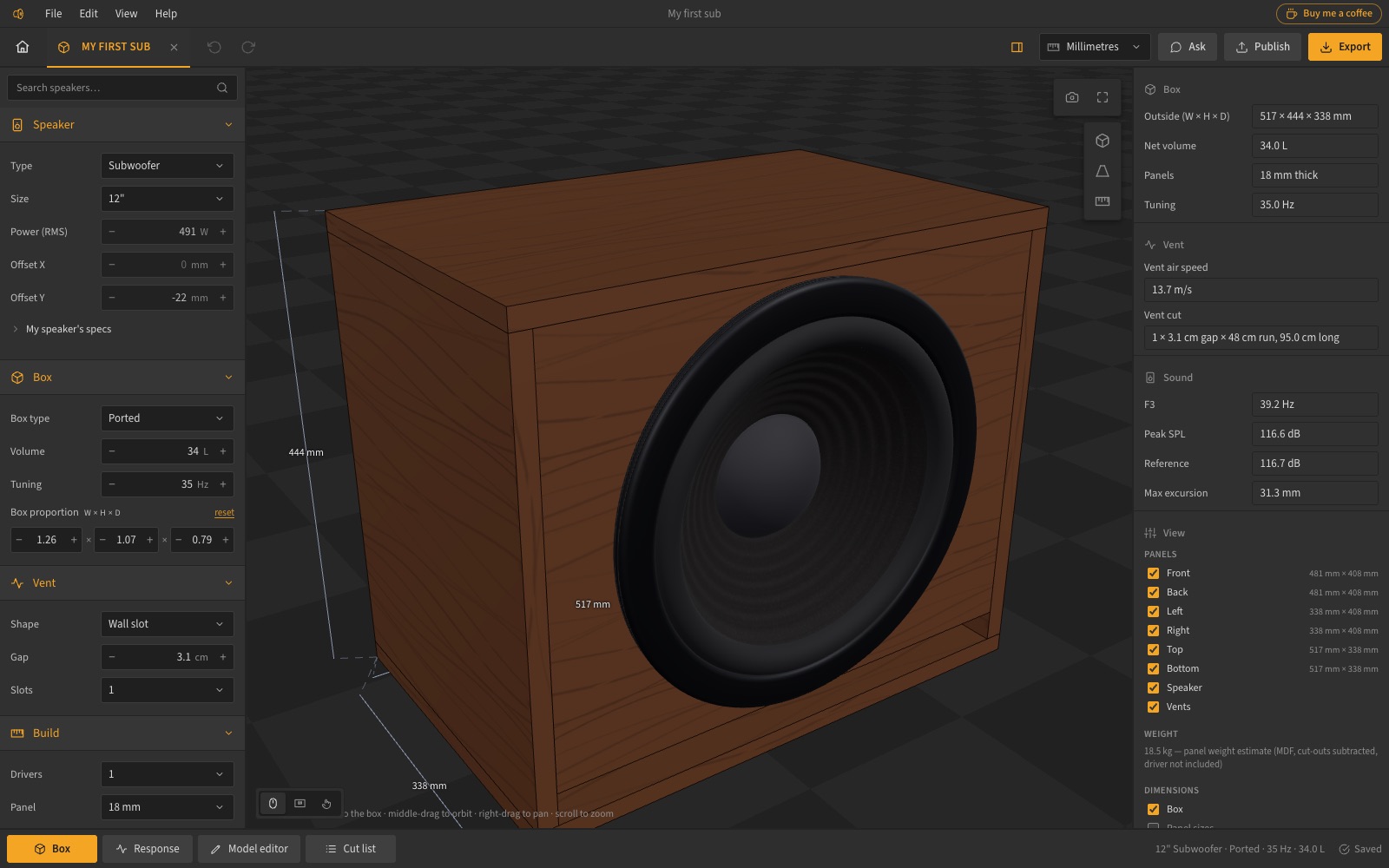
How the app handles it for you
In real life you would juggle box size and vent length by hand. In DIY Sounds you simply type the tuning you want:
- Volume — the box size in litres.
- Tuning — the Fb you want. Start near your speaker's Fs.
- Vent cut — the app works out how long to cut the vent.
Change the Volume and the app keeps your tuning and re-cuts the vent: a bigger box gets a shorter vent. To move the tuning itself, change Tuning.
Tuning a bandpass box
A bandpass box plays a band of bass and cuts off notes above and below it.
4th order — only the front chamber has a vent, so there is one tuning. It sets where the band sits. The sealed rear chamber sets how firmly the cone is held.
6th order — each chamber has its own vent and its own tuning. The rear tuning sets the bottom of the band and the front tuning sets the top. The app starts the front 30 Hz above the rear, for example 45 / 75 Hz. Too far apart and the middle of the band sags.
Small vent, big problem: chuffing
All the air the vent moves has to squeeze through it. Make the vent too small and the air rushes through so fast that you hear it — a "whoosh" or "puff" on every bass note. That noise is called chuffing (or port noise).
It also steals output: a noisy vent is a lossy vent.
The number to watch is vent air speed. Keep it under about 17 m/s at full power and you won't hear the vent. Above about 25 m/s it chuffs.
Turn on JavaScript to drag the sliders and watch the air speed change.
Try it: will the vent chuff?
The same 12" subwoofer and box, played at full power.
Air speed 45.5 m/s · Chuffs
Vent length needed for the same tuning: 24 cm
Your turn: with the power at full, make the vent wide enough that the air speed drops under 17 m/s. Then look at how long the vent has to be.
Quiet! But notice the catch: the wider vent needs a much longer duct.
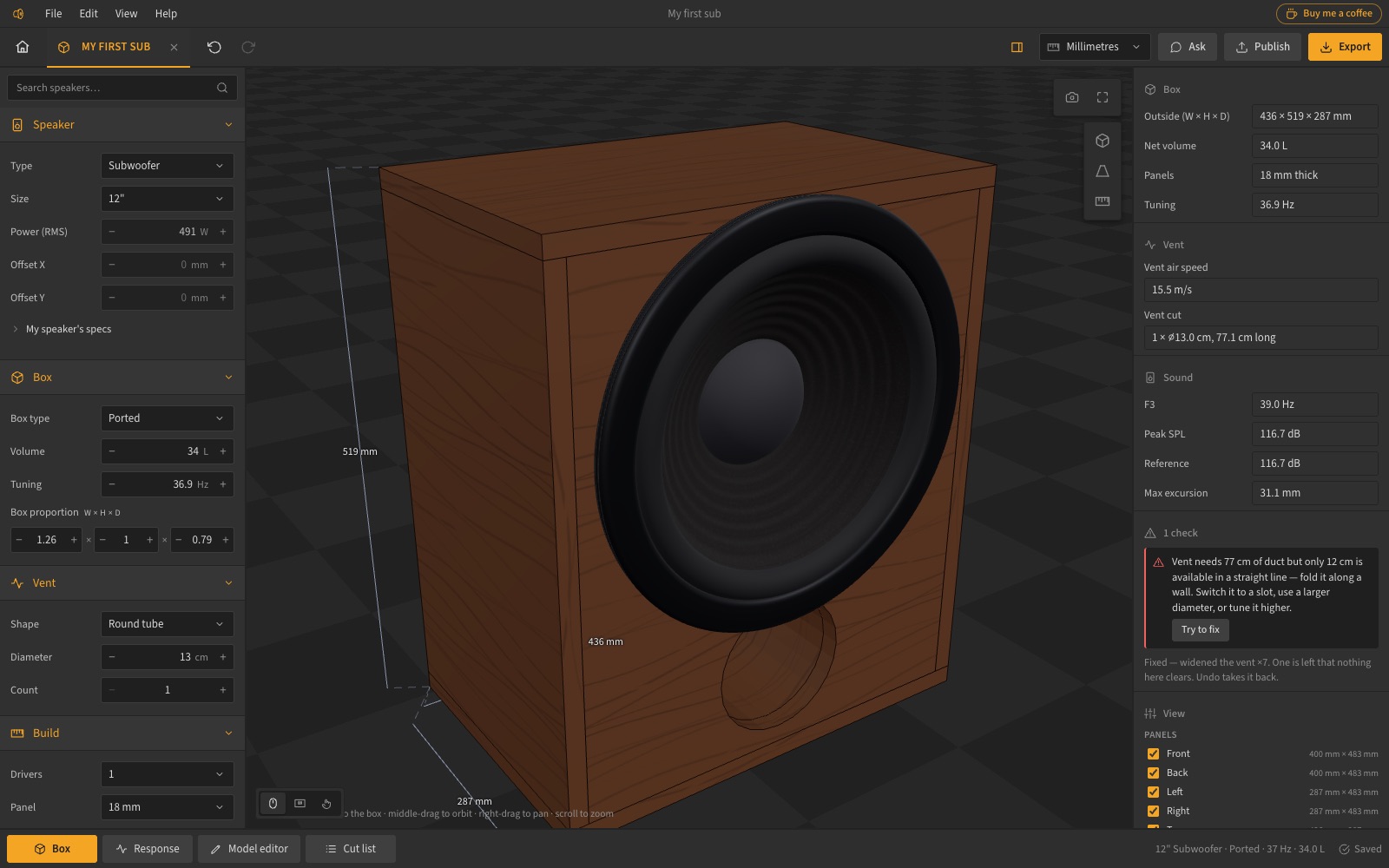
How to fix chuffing — and the catch
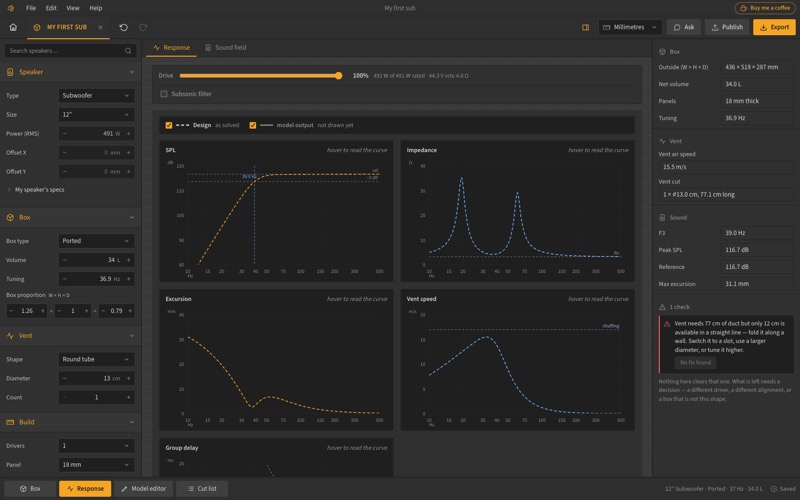
The cure is more vent area. The catch is that a wider vent needs a longer duct to keep the same tuning. Here the app widened the vent to 13 cm1. The air speed is now 15.5 m/s, which is quiet2, but the vent has to be 77 cm long3 and won't fit in a straight line, so the app warns4.
Ways out:
- Use a slot vent along a wall, and fold it if needed. The walls form the vent, so a long one fits. The app's New project designs do this.
- Use two vents to share the air.
- Make the box a bit bigger, which shortens the vent.
- Flare the vent ends. Rounded ends are quieter than sharp-cut tubes.
- Turn it down. Less power means slower air.
- Fb
- The box's tuning frequency.
- F3
- The note where the bass has fallen 3 dB below the rest. Lower means deeper.
- Net volume
- The air space inside, after the wood, speaker and vent are taken out.
- Qtc
- How "tight" a sealed box sounds. 0.707 is the classic flat choice.
- Subsonic filter
- An amp setting that cuts notes too low to hear, protecting the cone.
- dB
- Loudness. +3 dB is like doubling amplifier power.
Words you'll see
You now know the ideas behind every box: sealed for accuracy, ported for deep all-round bass, 4th order for smooth sub-bass, and 6th order for maximum loudness.
You also know that the box size and the vent set the tuning, that it belongs near your speaker's Fs, and that a vent that is too small chuffs.
Next: building one in the app.
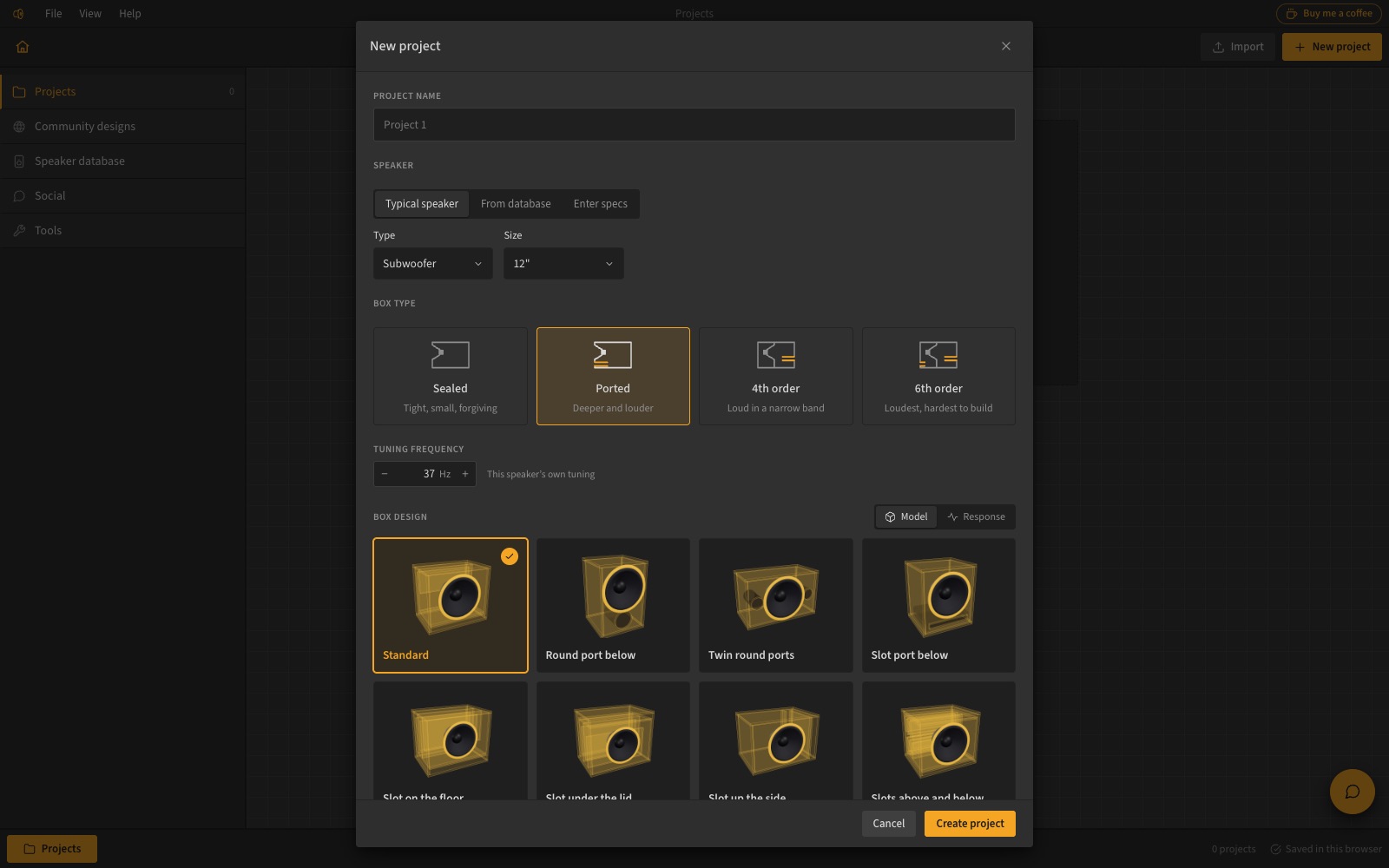
1. Start a new project
Open the app and press New project.
- Speaker — pick a typical one by type and size, search the database, or type its specs.
- Box type — sealed, ported, 4th or 6th order.
- Tuning frequency — already set to suit your speaker. Leave it to start.
- Box design — where the vents go. "Standard" is a safe first pick.
- Create project.
2. Find your way around
- Search speakers — swap in a real model.
- Speaker — type, size, power. My speaker's specs holds Fs, Qts, Vas, Xmax.
- Box — type, Volume and Tuning.
- Vent — its shape and size.
- Build — number of speakers and wood thickness.
- The box in 3D — drag to turn it.
- Results — outside size, vent air speed, F3, loudness.
- Views — Box, Response, Model editor, Cut list.
- Ask, Publish, Export — get help, share, or save.
Everything saves in your browser as you go, and ⌘Z / Ctrl+Z undoes any change.
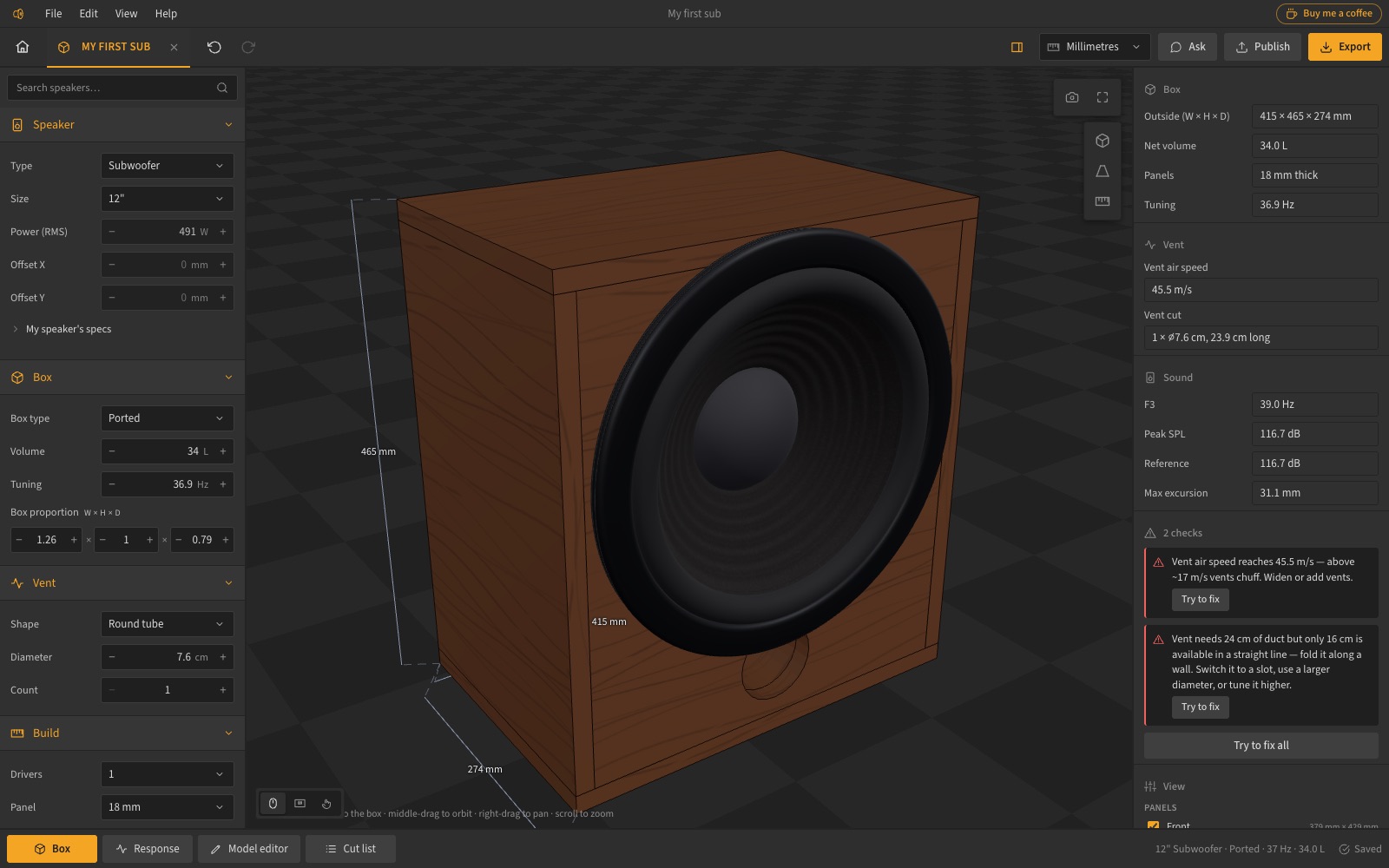
3. Read the checks
The app watches for the mistakes this guide covered. Here the vent was made smaller by hand, to 7.6 cm1:
- Air speed jumps to 45.5 m/s2 — far over the 17 m/s limit.
- A check explains the problem in plain words3.
- Try to fix4 has the app attempt a fix, and Undo takes it back if you don't like it.
Rule of thumb: a design with no checks left is a design you can build.
4. Check the sound, then cut
- Response — the bass curve, plus Vent speed with the chuffing line drawn on it. Slide Drive to see it at any power.
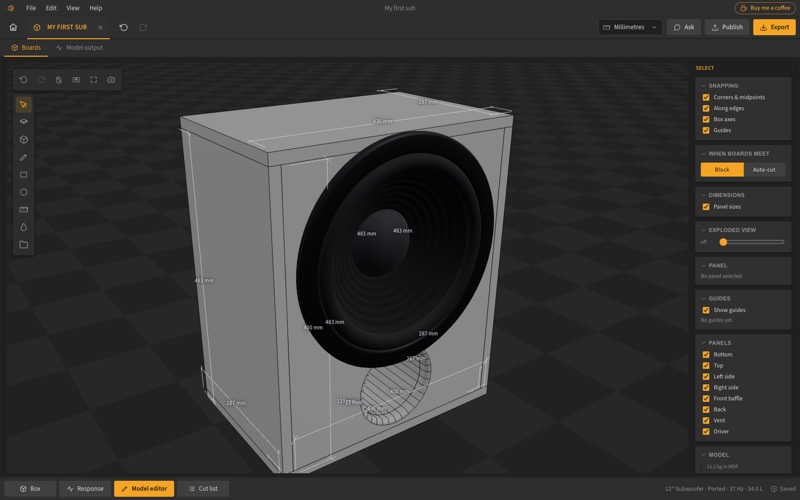
- Model editor — every board in 3D. Move or edit them; Model output re-checks the box you actually drew.
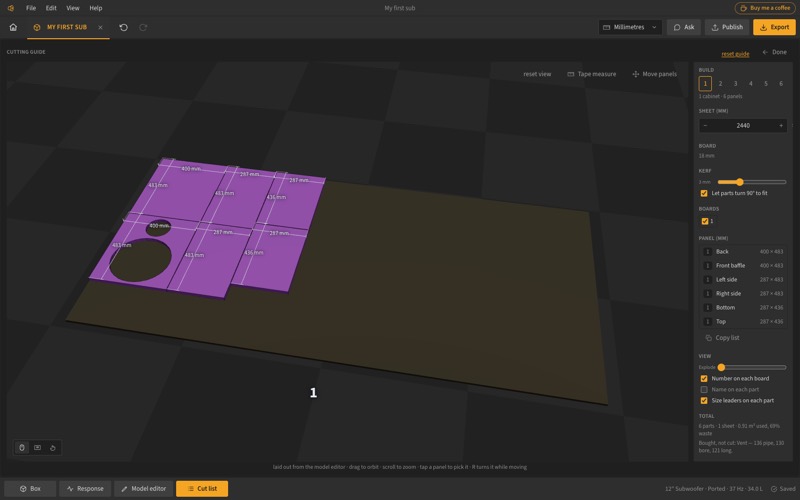
- Cut list — the boards laid out on a sheet with their sizes. Take it to the saw.
Export saves the project file, a picture or a spreadsheet of the cuts.
- 1Pick your speaker — or its type and size.
- 2Pick a box type from what you want to hear.
- 3Leave the tuning near your speaker's Fs.
- 4Clear every check — especially vent air speed.
- 5Look at the Response curve.
- 6Open the Cut list and build it.
Your first build, step by step
That's the whole loop. Pick a speaker, pick a box, keep the tuning near Fs, make sure the vent is big enough, and cut.
Stuck? Press Ask in the app and ask in plain words — "will my vent chuff?" or "make it play deeper".
Frequently asked questions
What is the best speaker box for a beginner?
A sealed or ported box. Sealed is the easiest and most forgiving: there is no vent to tune, and a box a little too big or small still sounds fine. Ported is one step harder but gives deeper, louder bass.
Leave bandpass boxes until you have built one of these.
Which speaker box is best for a studio, for outdoors, or for everyday music?
- Studio and recording → sealed. It is the most accurate, so you hear the bass as it really is.
- Everyday music and movies → ported. Deeper and louder, and good at everything.
- Loud, deep sub-bass in a car or home theatre → 4th-order bandpass.
- Outdoor parties and maximum loudness → 6th-order bandpass.
Sealed or ported — which sounds better?
Neither — they do different jobs. Sealed is tighter and more accurate and needs more amplifier power. Ported plays deeper and about 3 dB louder at the bottom from the same speaker, in a bigger box, with a vent that must be big enough not to chuff.
How do I lower my box tuning?
Make the box bigger, or the vent longer or narrower. Any of these lowers the tuning frequency. In DIY Sounds you type the tuning you want and the app works out the vent length for your box.
What causes port noise or chuffing?
A vent that is too small for the air it has to move. The air speeds up until you can hear it. Keep the peak air speed under about 17 m/s at full power: use a bigger vent, two vents, or a slot vent along a wall, and flare the ends.
Remember that a bigger vent needs a longer duct for the same tuning.
What is a 6th-order bandpass box good for?
Maximum loudness over a band of bass, usually outdoors. Both chambers are vented and both vents play, so it is very loud for the power. It is the hardest box to build, with two tunings that both have to be right, and it gives up some very deep bass and accuracy.
Design your first box
Pick a speaker and a box type — the size, the tuning, the vent and the cut list follow.
More calculators
Sealed box calculator
Solve the box from a target Qtc, and see where it rolls off.
Ported box calculator
Volume, tuning and vent, with the air-speed check people skip.
Bandpass box calculator
4th and 6th order — loud over a band, and quiet everywhere else.
Thiele/Small parameters
What Fs, Vas, Qts and Xmax mean, and which ones decide the box.